Comparison
MrCool vs Mitsubishi Mini Splits 2026: DIY Convenience or Premium Performance?
The short answer
Mitsubishi vs MrCool: The Short Answer.
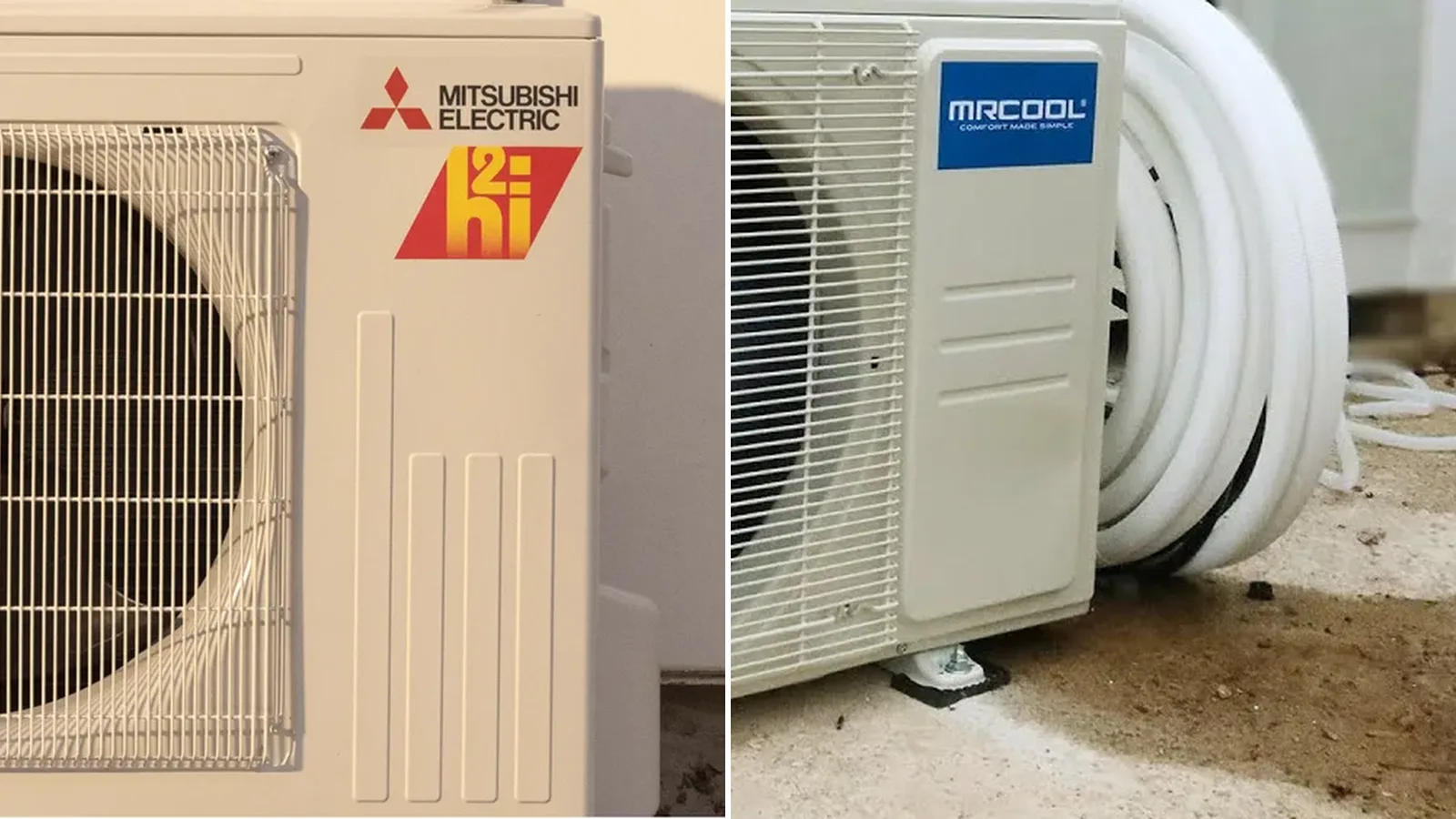
Mitsubishi and MrCool solve the same problem from opposite ends. Mitsubishi builds premium, professionally installed heat pumps, with top single-zone units rated past 30 SEER2. MrCool builds pre-charged, quick-connect DIY kits a homeowner can install for less than a comparable Mitsubishi once labor is counted.
If a licensed contractor is doing the work and you want the most efficient system, Mitsubishi is the stronger pick. If you're comfortable mounting the units yourself and want to skip a four-figure install bill, MrCool is the one to beat. We aggregate manufacturer specs, warranty documents, and public owner and installer reports rather than testing units ourselves, and across those sources the choice lands the same way almost every time. The at-a-glance grid below shows where each brand leads; the sections after it dig into efficiency, install, price, and warranty.
At a glance: where each brand leads
Installation
MrCool
Designed heavily around DIY installation. Many systems use pre-charged quick-connect line sets and do not require conventional refrigerant work.
Mitsubishi Electric
Generally requires professional installation, including flaring, vacuuming and commissioning the refrigerant lines.
Efficiency and Cold-Weather Performance
MrCool
Offers efficient inverter systems, and cold-weather ratings vary by model: the standard DIY 5th Gen operates to -13°F and the DIY Hyper Heat to -22°F.
Mitsubishi Electric
Often offers higher-end efficiency, with Hyper-Heating models designed for cold climates.
Price
MrCool
Lower total installed cost, especially when the homeowner completes the installation.
Mitsubishi Electric
Higher equipment and installation cost. The customer is paying for premium engineering, professional installation and stronger dealer support.
Warranty, Parts and Service
MrCool
DIY 5th Gen units carry a 5-year parts / 7-year compressor warranty that covers homeowner installation and needs no registration. Labor is not covered.
Mitsubishi Electric
Supported by a large professional dealer network. Replacement parts, technical support and trained service technicians are generally easier to access through authorized channels.
Efficiency & cold climate
Efficiency and Cold-Climate Performance Compared.
Mitsubishi wins on paper efficiency. Its high-end single-zone units are rated past 30 SEER2 (a Mitsubishi FX-series 12k scores around 29.9 SEER2 and 12.4 HSPF2), while the MrCool DIY 5th Gen 12k is rated 23.5 SEER2 and 10.2 HSPF2. In mild and moderate climates that gap is smaller than the raw numbers suggest.
Cold-weather ratings depend on the model. Mitsubishi's Hyper-Heat (H2i) lines are engineered for cold climates. MrCool's standard DIY 5th Gen units operate to -13°F, and its DIY Hyper Heat models operate to -22°F.
Noise is close on paper. Aggregated spec sheets put Mitsubishi indoor heads near 19 to 22 dB(A) at their quietest, and MrCool's catalog lists the DIY 5th Gen 9k and 12k indoor units as low as 18 dB(A) on the lowest fan setting. Both are quiet. For a room you cool in a temperate climate, either brand delivers. Match the model to your climate zone rather than the brand name, since both makers sell a wide efficiency range.
Installation
Installation: Pro-Only vs DIY.
This is where the two brands differ most. MrCool DIY kits ship with a pre-charged, quick-connect line set, so a homeowner with basic tools can mount the indoor head, hang the condenser, couple the lines, and power up, with no refrigerant gauges, no vacuum pump, and no EPA Section 608 certification. Mitsubishi takes the opposite approach. Its outdoor units ship factory-charged, but the field-run lines must be evacuated, so its systems require a licensed HVAC technician to flare the lines, pull a vacuum, charge the refrigerant, and commission the system, and on most Mitsubishi lines the warranty is tied to that professional install. That's the real fork in the road: MrCool removes the contractor, Mitsubishi requires one.
Sizing matters for both, and getting it wrong hurts either brand. Base the capacity on a Manual J load calculation rather than guessing from square footage, since an oversized unit short-cycles, controls humidity poorly, and wastes energy.
General BTU sizing guidelines
- 9k BTU: small bedrooms, home offices
- 12k BTU: medium rooms, standard bedrooms
- 18–24k BTU: large living spaces, open floor plans
- 36k+ BTU: multi-zone whole-home systems
Even if you're set on MrCool DIY, it's worth getting one professional quote so you understand the electrical, condensate, and line-set work before you commit.
Cost
Price: Equipment vs Total Installed Cost.
On total installed cost, MrCool wins by a wide margin, and the gap is almost entirely labor. A single-zone MrCool DIY 12k kit runs about $2,359 at Home Depot (September 2026), and because the homeowner does the work, that's close to the all-in number. A comparable Mitsubishi 12k unit adds professional installation, which often nearly doubles the total, so figure $3,500 to $7,000 per zone installed depending on complexity and region.
Installed cost comparison
- MrCool DIY: close to equipment-only price since homeowners handle labor themselves.
- Mitsubishi: $3,500–$7,000+ per zone installed, depending on complexity and region.
The counterweight is operating cost. A Mitsubishi system running 29-plus SEER2 uses less electricity than a lower-SEER2 unit, and utility or federal rebates can trim the upfront gap further. If you plan to stay long enough to bank those savings, the math tightens. If not, MrCool's lower entry price is hard to argue with. Verify current pricing against live listings, since both brands' prices move with the season.
Reliability & warranty
Reliability and Warranty Compared.
The warranty gap is the clearest number in this comparison. Mitsubishi offers up to 12 years of parts and compressor coverage when the system is installed by a Diamond Contractor and registered within 90 days, versus MrCool's 5-year parts and 7-year compressor coverage on DIY 5th Gen units, which requires no registration (the DIY Select tier carries 1-year parts / 2-year compressor).
Service works differently, too. Mitsubishi's dealer network and Diamond Contractor program make trained technicians, replacement parts, and technical support available through authorized channels. The combination of a longer warranty and a dealer service network is what buyers are really paying the Mitsubishi premium for.
The verdict
Which Should You Buy?
Start with who's doing the install, because that single decision resolves most of the choice. If you want to avoid hiring a contractor and keep the project under a weekend, lean DIY. If you want the most efficient heat pump you'll keep for 10 to 15-plus years and you're fine paying a pro, lean Mitsubishi. Climate is the tiebreaker: through sub-zero winters, Mitsubishi's Hyper-Heat performance is worth the premium, while in mild and moderate regions a DIY kit covers the job for a fraction of the cost.
What to buy, based on budget
- <$1,000: Window AC or portable air conditioner
- <$2,000: Consider more affordable DIY options like Zone Air's DIY series
- <$3,000: Consider all DIY brands (Zone Air and MrCool)
- <$5,000: Consider Mitsubishi
Two habits save money either way. Compare specific models, not just brand names, since both makers span a wide efficiency and price range. And even if you're leaning MrCool DIY, get one professional quote so you see the full installation picture before committing. Think about the ownership timeline as well: a forever home justifies Mitsubishi's efficiency, while a five-year plan or a rental tilts toward MrCool's lower entry price. Neither brand is universally better. The right call comes down to your install comfort, climate, budget, and how long you expect to keep the system.
Alternatives
Alternatives Worth Considering.
MrCool and Mitsubishi aren't the only two names on the DIY-versus-premium spectrum. Between them sits a group of pre-charged DIY brands built for homeowners who want a self-install without paying for a Mitsubishi install.
Zone Air sells pre-charged 115V DIY systems rated up to 24 SEER2, starting at $1,899. That combination of a standard household plug, a no-vacuum install, and a SEER2 rating that reaches into premium territory is what puts it in the conversation for DIYers who found Mitsubishi's install bill a little steep.
The true-DIY shortlist is short: MRCOOL and Zone Air ship factory-charged linesets, while every other 'DIY' unit in this guide is a flare install that needs a vacuum pump.
Other DIY-labeled options exist as well. Senville and Pioneer both sell budget lines, though those use traditional flare installs that require a vacuum pump and EPA 608 handling, which pulls them back toward the pro-install side. For most shoppers the honest shortlist stays short: MrCool for a self-install, Mitsubishi for pro-grade cold-climate performance, and a pre-charged high-SEER2 alternative like Zone Air if you want to split the difference. Verify current specs and pricing against each brand's live listings as of July 2026, since models and prices shift through the year.
MrCool vs Mitsubishi: frequently asked questions
- Q.01Is MrCool as good as Mitsubishi?It depends on your priority. MrCool costs less once labor is counted and installs without a contractor. Mitsubishi's top single-zone units reach past 30 SEER2 with up to 12-year coverage, while the MrCool DIY 5th Gen 12k is rated 23.5 SEER2 and carries 5-year parts / 7-year compressor terms.
- Q.02Is MrCool the same company as Mitsubishi?No. MrCool is a separate American company based in Hickory, Kentucky, and Mitsubishi Electric is a Japanese company with its own dealer network. The two are competitors, not the same brand.
- Q.03Can you install a MrCool yourself but not a Mitsubishi?Generally yes. MrCool DIY kits use a pre-charged, quick-connect line set a homeowner can install with basic tools and no EPA Section 608 certification. Mitsubishi outdoor units ship factory-charged, but the field-run lines must be evacuated, so they need a licensed technician to pull a vacuum and handle the refrigerant, and on most lines the warranty depends on that professional install.
- Q.04Which is better for cold climates, MrCool or Mitsubishi?It depends on the model. Mitsubishi's Hyper-Heat (H2i) lines are engineered for cold climates. MrCool's standard DIY 5th Gen units operate to -13°F, and its DIY Hyper Heat models operate to -22°F.
- Q.05How long do MrCool and Mitsubishi mini splits last?Lifespan for both depends heavily on install quality, correct sizing, and maintenance.
- Q.06Are Mitsubishi mini splits quieter than MrCool?Not by much on paper. Aggregated spec sheets put Mitsubishi indoor heads around 19–22 dB(A), and MrCool's catalog lists the DIY 5th Gen 9k and 12k indoor units as low as 18 dB(A) on the lowest fan setting. Both are quiet enough for a bedroom.
- Q.07Which mini splits are truly DIY?Truly DIY mini splits ship pre-charged with quick-connect line sets, so you install them without a vacuum pump or EPA 608 certification. Of the brands covered here, only MRCOOL and Zone Air fit that bar. Many other 'DIY'-branded units still need a flare install. See our full true-DIY guide.