Buyer's guide · DIY 3-Zone
Best DIY 3-Zone Mini Split 2026: Zone Air vs MRCOOL vs Cooper & Hunter
Shopping for a 3-zone mini split system in 2026 means sorting through dozens of brands, wildly different install requirements, and efficiency ratings that weren't even measured the same way two years ago. This guide cuts through the noise. We compared the three brands that come up most often-Zone Air, MRCOOL, and Cooper & Hunter-and tested them against what actually matters: whether most homeowners can install them, how efficiently they heat and cool multiple rooms, and what the total cost looks like when the project is done.
Quick answer: the best DIY 3-zone mini split system in 2026
- Zone Air combines true quick connect fittings, up to 24 SEER2 energy efficiency, and cold-climate heating down to −13°F into a genuinely homeowner doable package. No vacuum pump, no micron gauge, no HVAC license required. The 7-year compressor warranty and 5-year warranty on parts hold even when you self install.
- MRCOOL DIY 5th Gen is the best pick when you need same-day pickup from a local retailer. It's a proven diy system with pre charged line sets and solid performance, though efficiency and indoor unit flexibility usually trail Zone Air at comparable price points.
- Cooper & Hunter multi zone hyper heat pumps lead in extreme cold-rated down to −22°F-but they require an HVAC tech for line set installation, adding $3,000–$5,000 to total cost. Not a true diy mini split by any stretch.
How DIY 3-zone mini splits work
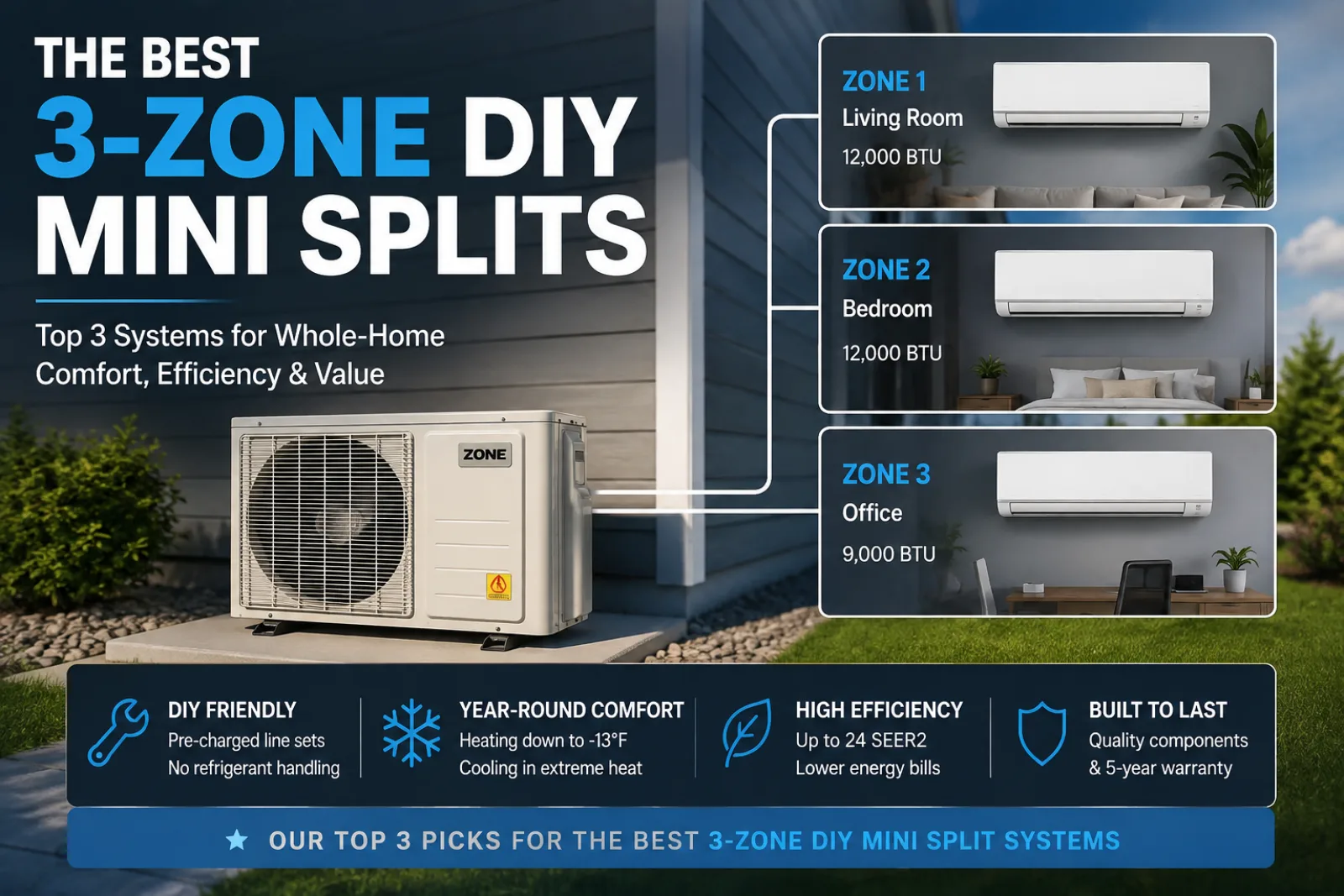
A 3-zone mini split system is simple at its core: one outdoor unit (the heat pump compressor) connects to three indoor units, each mounted in a different room. Every zone gets independent climate control, so the bedroom can be 68°F while the living room sits at 72°F and the garage stays at 60°F.
Here's the high-level picture of how mini splits work:
- The outdoor unit compresses refrigerant and moves it through line sets to each indoor air handler.
- Each indoor head contains an evaporator coil and fan that delivers air conditioning in summer and heating in winter. Ductless systems provide both heating and cooling from a single unit.
- Modern inverter heat pumps modulate output continuously instead of cycling on/off, which is why they're so much quieter and more efficient than window units or older central AC.
- DIY mini split systems provide independent climate control for multiple rooms, each with its own thermostat and remote.
- Modern heat pumps can operate in sub-zero climates, and ductless mini splits can operate in temperatures as low as −13°F in many models.
- 2026 systems commonly support wall-mount heads, ceiling cassette units, and slim concealed ducted air handlers on the same condenser-mixing styles to match each room.
The key difference between single-zone and 3-zone: a single-zone system heats or cools one room (great for a garage or bonus room), while a multi zone system covers an entire house floor or small home with multiple indoor heads on one outdoor unit.
2026's top 3-zone DIY mini split picks at a glance
This is the fast comparison-detailed breakdowns follow in later sections.
- Zone Air 3-Zone DIY (Best overall DIY multi zone): 27,000–36,000 BTU outdoor condensers, up to 24 SEER2, R-454B refrigerant, heating to −13°F. True diy install with pre charged lines and quick connect fittings.
- MRCOOL DIY 5th Gen Multi-Zone (Best for retail pickup): 18,000–36,000 BTU condensers supporting 3–5 heads, approximately 23 SEER2, R-454B in most current stock. A 23 SEER2 rating uses significantly less electricity than older systems. Same quick connect diy installation concept.
- Cooper & Hunter Hyper Heat Multi-Zone (Best pro install for extreme cold): 28,000–36,000 BTU outdoor units, up to 22 SEER, heating to −22°F. Uses R-410A in most 2025–2026 inventory. Requires professional installer with HVAC tools.
- Zone Air and MRCOOL are the only widely available multi zone systems in 2026 that qualify as genuine diy mini split installs without needing an HVAC tech on the refrigerant side.
- Always factor total installed cost (equipment + labor) rather than sticker price. Detailed pricing and sizing are covered below.
Zone Air 3-Zone DIY system: best overall in 2026
Zone Air is the leading diy mini split brand for 3-zone installations in 2026. Its systems are designed from the ground up for homeowner installation, with efficiency and cold-climate capability that rival pro-install brands costing twice as much.
- Typical 3-zone packages: The flagship is a 27,000 BTU outdoor condenser paired with three 12,000 BTU wall-mount indoor units (36,000 BTU connected capacity), covering up to 1,800 square feet. Each head comes with its own remote and Wi-Fi app control. Smart features in HVAC systems allow for Wi-Fi control and compatibility with voice assistants.
- True DIY install: Zone Air ships with pre charged line sets using R-454B refrigerant in multiple lengths (16-ft, 25-ft, 35-ft). No vacuum pump, manifold gauges, or refrigerant handling required. Zone Air's installation requires only one wall hole to drill per indoor unit.
- Efficiency and performance: Zone Air offers up to 24 SEER2 efficiency, with HSPF2 around 10.5 for Region IV. Some mini splits are rated for heating at −13°F, and Zone Air hits that mark, making it suitable for most U.S. cold-climate regions.
- Warranty: Zone Air's warranty covers self installation for 5 years on parts and 7 years on the compressor. Five-year warranties are common for DIY HVAC systems to protect against defects, and Zone Air's explicit coverage of diy install is rare among multi zone systems.
- Flexible indoor units: Zone Air supports wall mounts, ceiling cassette units, and slim concealed ducted heads (Thin-Air), allowing configurations like two bedrooms with wall units plus a living room with a cassette.
- Price: The 36,000 BTU 3×12K wall-mount kit lists at $3,509.99. Cassette and ducted configurations run $4,900–$7,300.
MRCOOL DIY 5th Gen Multi-Zone: the runner-up DIY 3-zone
Mr Cool is the most recognized name in diy mini split systems, and the 5th Gen multi zone lineup is its strongest offering yet. It's the closest competitor to Zone Air for homeowners who want a 3-zone ductless system they can install themselves.
- Lineup: MRCOOL offers multi zone condensers from 18,000 BTU (three 9K heads) up to 36,000 BTU (supporting up to five heads). The MRCOOL DIY 5th Gen is also available as a single-zone rated 12,000 BTU and 115V for small room applications.
- Refrigerant and efficiency: Most current MRCOOL DIY 5th Gen units use R-454B, though some legacy R-410A stock remains in certain 27K 3-zone bundles. SEER2 ratings land around 23–23.9 for the 3-zone configurations-strong, but typically a step below Zone Air's peak 24 SEER2.
- Biggest advantage: Wide retail availability. Many homeowners can walk into a big-box store and buy a 3-zone kit for a same-week project. MRCOOL wins on off-the-shelf convenience.
- Drawbacks vs Zone Air: Slightly lower efficiency at equivalent price points. Less flexibility for mixing ceiling cassette and ducted heads-most MRCOOL 3-zone diy bundles are wall-mount only. Warranty language can be more restrictive; extended coverage sometimes requires registration in the MRCOOL Care Program.
- Still true DIY: MRCOOL DIY systems require no HVAC license for installation. Pre charged line sets, quick connect fittings, no vacuum pump or micron gauge needed. An electrician is often needed for 240V electrical work, same as with Zone Air.
- Price: 3-zone 18K bundles (9K+9K+9K) range from roughly $2,500–$4,000 depending on accessories and line set inclusion.
Cooper & Hunter 3-zone Hyper Heat: pro-install performance pick
Cooper & Hunter multi zone systems aren't DIY, but they matter as performance benchmarks-especially for winter heating in extreme climates.
- Hyper heat models: 28K–36K BTU outdoor units rated for heating down to −22°F ambient. Hyper-heat mini splits extract heat from cold outdoor air using enhanced compressor and coil technology, delivering usable warmth even when most standard systems would shut down.
- Efficiency: HSPF2 ratings often land between 11 and 13 in hyper heat configurations, with SEER up to about 22 in select models. Solid but not class-leading for cooling.
- Indoor unit variety: Wall mounts, compact ceiling cassettes, and floor-mount consoles. Good flexibility for an HVAC tech designing a whole-home system.
- Not DIY: Cooper & Hunter ships traditional flare-style line sets that must be vacuumed, pressure-tested, and charged with refrigerant. You'll need HVAC tools, an EPA-certified technician, and a professional install appointment. Professional installation costs often exceed equipment prices.
- Refrigerant: Most 2025–2026 hyper heat stock still uses R-410A, though newer models are transitioning to R-454B or R-32.
- Who it's for: Homeowners in very cold regions (Minnesota, upstate New York, Alaska) who prioritize hyper heat over diy installation and are comfortable hiring a contractor. The equipment cost may look competitive, but professional installation typically adds $3,000–$5,000.
DIY vs pro-install: what "true DIY mini split" means in 2026
A true diy mini split system is one where the home owner does not need to handle refrigerant, vacuum line sets, or own specialized HVAC tools. Installation of ductless mini splits can be DIY with pre-charged line sets-that's the dividing line.
- Quick connect systems (Zone Air, MRCOOL DIY): Ship with sealed, pre charged line sets and factory-sealed indoor units. The install is mechanical-mounting, routing, tightening-rather than refrigerant work. This is what makes a system genuinely homeowner doable.
- "Fake DIY" systems: Some brands pre-charge the condenser but still require you to vacuum, flare, and pressure-test the line set connections. That demands a vacuum pump, micron gauge, manifold gauges, and often an HVAC license. Many manufacturers sell these as "DIY" online, but the honest answer is they're pro install systems with shipping boxes.
- Code boundaries: Homeowners can usually handle the refrigerant-side diy install on true quick connect systems, but may still need a licensed electrician for 240V circuits or sub-panel upgrades. Local codes vary-check yours.
- Traditional brands like Cooper & Hunter, Senville, and Pioneer make great mini split systems, but are pro install only. Calling your local HVAC guy is part of the deal.
- DIY mini splits eliminate the need for HVAC technician visits on the refrigerant side, and choosing a true diy system can save $3,000–$5,000 per 3-zone project while maintaining warranty coverage when installed correctly. DIY installation saves $3,000 to $5,000 on average across multi zone projects. Even on simpler installs, self-installing a mini split can save about $1,000 in install labor.
Sizing a 3-zone mini split system correctly
Proper sizing matters as much as brand choice. An oversized unit short-cycles and leaves humidity high; an undersized one can't keep up during peak heat or cold.
- Rule of thumb: Around 18–25 BTU per square foot depending on climate, insulation quality, and room use (kitchens and sun-facing rooms need more). Use Zone Air's mini split sizing calculator for a quick estimate.
- Common 3-zone layouts: Three 300–400 square foot bedrooms → three 9,000 BTU heads (27K total). A living room (450 sq ft), kitchen (350 sq ft), and office (250 sq ft) → 12K + 12K + 9K heads. You need to size your mini split to each room, not just total square footage.
- Connected vs outdoor capacity: Zone Air's 27K condenser supports up to 36K connected indoor capacity because all three heads rarely run at peak simultaneously. This is standard multi zone design-not a flaw.
- Watch for: Ceiling height above 8 feet, large west-facing windows, poor insulation, and open-plan rooms that connect to unconditioned spaces. These push BTU needs higher.
For complex homes or open floor plans, a quick load calculation from an HVAC pro or online calculator is worthwhile even if the installation itself is DIY.
Installation overview: how a DIY 3-zone mini split install actually goes
A diy install of a 3-zone system is a full-day or weekend project. It's accessible for moderate DIYers with basic tools, but it's not a two-hour job. Here's what the install process actually looks like.
- Plan locations: Decide where each indoor unit goes (usually high on an interior wall) and where the outdoor condenser sits (level pad, good airflow, accessible).
- Mount indoor units: Install mounting plates, drill one wall penetration per head for the line set and drain, and hang each air handler.
- Set up the outdoor unit: Place on a condenser pad or wall brackets. Route and secure each pre charged line set from indoor heads to the condenser.
- Connect: Attach quick connect fittings at each end of the line set, tighten drain lines, and open service valves. With Zone Air's pre charged lines, no vacuum pump, manifold gauges, or refrigerant charging are needed.
- Electrical: Run dedicated 208–230V power to the outdoor unit (typically a 30A double-pole breaker for 36K BTU systems). This electrical work may require a licensed electrician depending on your jurisdiction.
- Timeline: 4–6 hours for experienced DIYers on a single-story home. 1–2 days for first-timers or multi-story layouts with longer line set runs.
MRCOOL's process is broadly similar. Cooper & Hunter and other non-DIY brands require pulling a vacuum, pressure testing, and charging-adding another appointment with a professional installer.
Wall mounts, ceiling cassettes, and ducted heads in 3-zone systems
Modern 3-zone mini split systems can mix different indoor unit types on the same condenser. The right mix depends on room layout and aesthetics.
- Wall-mount heads are the simplest and most common. They mount high on a wall, distribute air across the room, and work well for bedrooms, offices, and living rooms. Both Zone Air and MRCOOL offer these in their 3-zone bundles.
- Ceiling cassette units sit flush in a drop ceiling or can be surface-mounted. They're ideal for larger open spaces, rooms with limited wall real estate, or anywhere a more discreet look matters. Zone Air offers dedicated ceiling cassette options for its multi zone condensers.
- Slim concealed ducted heads hide behind a soffit or in a closet, delivering conditioned air through short duct runs. Perfect when buyers want ductless comfort without visible wall units-useful in formal living spaces or hallways.
- Zone Air supports all three styles on its multi zone condensers, enabling combinations like one wall unit in the bedroom, one cassette in the kitchen, and one ducted unit serving a hallway.
- MRCOOL's 3-zone diy options lean heavily toward wall-mount heads, with cassettes and ducted indoor units available in fewer configurations. Cooper & Hunter offers broad variety but requires pro install.
Efficiency, hyper heat, and operating cost in 2026
SEER2 and HSPF2 ratings directly determine how much money you spend on electricity every month. As utility rates climb in 2026, the gap between a 16 SEER2 air conditioner and a 24 SEER2 heat pump adds up fast. SEER2 efficiency ratings are crucial for energy savings.
- SEER2 measures cooling efficiency; HSPF2 measures heating efficiency. Basic mini splits land around 16–18 SEER2. High SEER2 ratings can exceed 24 for mini splits, and units with higher SEER2 ratings save more on electricity bills over the system's 15-year life.
- Zone Air reaches up to 24 SEER2 in its 3-zone wall-mount configurations. Ductless mini splits can achieve up to 24 SEER2 efficiency ratings, putting Zone Air at the top of the diy class.
- MRCOOL lands around 23–23.9 SEER2 for comparable 3-zone bundles. Still strong-but that gap compounds over years of operation.
- Cooper & Hunter hyper heat models prioritize cold-weather performance over peak cooling efficiency, often reaching HSPF2 of 11–13 but topping out around 22 SEER for cooling.
- Hyper heat capability means a system can deliver usable heating at very low outdoor temperatures. Zone Air and MRCOOL maintain rated output to around −13°F. Cooper & Hunter hyper heat extends to −22°F in select models-critical for truly extreme climates.
- Even modest efficiency differences can save hundreds of dollars over the system life, especially in climates with long cooling or heating seasons. Energy Star certifications indicate high energy efficiency in HVAC products, and Energy Star units typically have higher SEER2 ratings. Look for these labels when comparing.
Compare SEER2 tier, minimum operating temperature, and refrigerant type-not just headline BTU and price-when evaluating any mini split system.
Refrigerants and future-proofing: R-454B vs R-410A
EPA rules under the AIM Act are phasing down older, high-GWP refrigerants. For anyone buying a mini split in 2026, refrigerant choice affects long-term serviceability and cost.
- R-410A is still common in Cooper & Hunter and some legacy mini splits. It works well but has a higher global warming potential and is being phased out, meaning future service calls may cost more as supply tightens.
- R-454B is the lower-GWP replacement adopted by Zone Air and MRCOOL diy lines. It's aligned with current and upcoming regulations, making systems more future-proof over a 10–15 year lifespan.
- Both refrigerants are safe and effective when installed correctly. R-454B simply offers regulatory and environmental advantages for new installations.
Homeowners choosing R-454B-based diy mini splits in 2026 are likely to face fewer refrigerant availability and cost issues down the road.
Cost breakdown: DIY vs contractor 3-zone projects
Multi zone HVAC quotes surprise most homeowners because install labor can exceed equipment cost. Here's where the money actually goes.
| Cost Category | Zone Air 3-Zone DIY | MRCOOL 3-Zone DIY | Cooper & Hunter 3-Zone (Pro Install) |
|---|---|---|---|
| Equipment | $3,500–$5,500 | $2,500–$5,000 | $2,500–$4,500 |
| Professional installation / labor | $0 (self install) | $0 (self install) | $3,000–$5,500 |
| Electrician (if needed) | $200–$600 | $200–$600 | Included in labor |
| Misc (pad, covers, brackets) | $100–$300 | $100–$300 | Included in labor |
| Estimated total cost | $3,800–$6,400 | $2,800–$5,900 | $5,500–$10,000+ |
- DIY buyers using Zone Air or MRCOOL can realistically save $3,000–$5,000 per 3-zone project, especially in high-labor-cost metro areas.
- Homeowners can receive energy savings and rebates through efficient HVAC systems. Federal tax credits and utility rebates for high-efficiency heat pumps are available in 2026, and Zone Air's seer rating and cold-climate capabilities often qualify.
- The numbers are clear: professional installation costs often exceed equipment prices. Choosing a true diy system keeps total cost closer to what the hardware is actually worth.
When a 3-zone mini split makes more sense than central HVAC
A 3-zone ductless system isn't always the answer-but in these common 2026 scenarios, it usually is.
- Older homes without ducts. Retrofitting ductwork into a 1940s colonial costs a fortune. A mini split system skips that entirely.
- Additions and garages where extending existing ductwork is expensive or impossible. A mini split for the garage plus two room heads handles this cleanly.
- Upstairs zones that stay too hot because central AC can't balance airflow between floors.
- Partial electrification projects replacing oil, propane, or electric baseboard heat. Cold climate heat pumps can replace electric baseboard heat efficiently, cutting energy bills dramatically.
- Ductless systems lose no energy through leaky ductwork-traditional ducted systems lose up to 30% of energy through ductwork, according to the Department of Energy.
Central HVAC may still win for large open-plan homes with existing, well-sealed ducts. But for room-by-room control and retrofit flexibility, mini splits are hard to beat.
Zone Air's diy-friendly design makes it realistic for homeowners to retrofit multi zone comfort without waiting weeks for a busy HVAC contractor.
How Zone Air stacks up against MRCOOL and Cooper & Hunter in 2026
Here's the side-by-side for buyers making a final decision on a 3-zone mini split in 2026.
| Feature | Zone Air | MRCOOL DIY 5th Gen | Cooper & Hunter Hyper Heat |
|---|---|---|---|
| True DIY install | ✅ Yes | ✅ Yes | ❌ No (pro install) |
| Max SEER2 (3-zone) | 24 | ~23.9 | ~22 |
| Cold-climate rating | −13°F | −13°F | −22°F |
| Refrigerant | R-454B | R-454B (some R-410A) | Mostly R-410A |
| Indoor unit mix options | Wall, cassette, ducted | Mostly wall mount | Wall, cassette, floor, ducted |
| Compressor warranty | 7 years | 7 years | 7 years (pro install only) |
| Warranty parts | 5 years (DIY OK) | 5 years | 5 years (pro install only) |
| Typical 3-zone cost (installed) | $3,800–$6,400 | $2,800–$5,900 | $5,500–$10,000+ |
- Choose Zone Air if you value true diy install, maximum long-term energy savings, and flexible indoor unit types. It's the brand that treats homeowner installation as the default, not an exception.
- Choose MRCOOL if you prioritize off-the-shelf availability and want a proven brand you can buy locally this weekend.
- Choose Cooper & Hunter if you're in extreme cold and already planning to hire a local HVAC guy. The hyper heat performance is unmatched, but so is the bill.
FAQ: 3-zone DIY mini splits in 2026
These are the questions homeowners ask most before pulling the trigger on a multi zone diy mini split project.
Can a homeowner legally install a diy mini split system?
Yes. Quick connect systems like Zone Air and MRCOOL are designed for non-licensed self installation-no refrigerant handling, no HVAC license needed. However, electrical and permitting rules vary by city. You may need a licensed electrician for the 240V circuit, and some jurisdictions require a permit for any HVAC install.
How long does a 3-zone diy install take?
Experienced DIYers typically finish a simple single-story 3-zone project in 4–6 hours. First-timers or complex multi-story layouts should budget 1–2 full days. Zone Air's step-by-step installation guide and tech support line can cut that learning curve significantly.
Does diy install affect the warranty?
It depends on the brand. Zone Air's warranty explicitly covers homeowner installation-7 years on the compressor, 5 years on warranty parts. Many traditional brands void coverage without a professional install receipt, which is one reason Cooper & Hunter requires a licensed technician.
How do mini splits perform in cold climates?
Modern heat pumps handle cold weather far better than models from even five years ago. Zone Air and MRCOOL are rated for heating at −13°F. Cooper & Hunter hyper heat reaches −22°F. For most of the northern U.S., −13°F covers the vast majority of winter heating days.
How loud are modern mini splits?
Indoor heads typically run around 28–32 dB-quieter than a whisper. Compare that to old window units at 50+ dB or a typical air conditioner cycling on and off. The outdoor unit runs around 60–62 dB, similar to a normal conversation.
What about energy rebates?
Homeowners can receive energy savings and rebates through efficient HVAC systems in 2026. Systems with high SEER2 ratings and Energy Star certification-like Zone Air's lineup-often qualify for federal tax credits and local utility incentives. Check the DSIRE database or your utility's website for current programs.
Where do I start?
Visit Zone Air's multi zone mini split page to browse 3-zone packages, use the BTU sizing calculator to confirm what you need, and reach out to the Zone Air tech support team with any questions before you buy. Getting the right system upfront is the single best thing you can do to guarantee years of ductless comfort and lower utility bills.
Calculator
Your run cost depends on your ZIP.
Run our calculator with your ZIP, your existing system, and the 3-zone configuration you're considering. It pulls climate and current electricity-rate data to show annual operating cost, savings, and simple payback.
Run the numbers for your home→