Buyer's guide · DIY Dual-Zone
Best DIY Dual-Zone Mini Splits in 2026: MRCOOL vs Senville vs Pioneer vs Zone Air
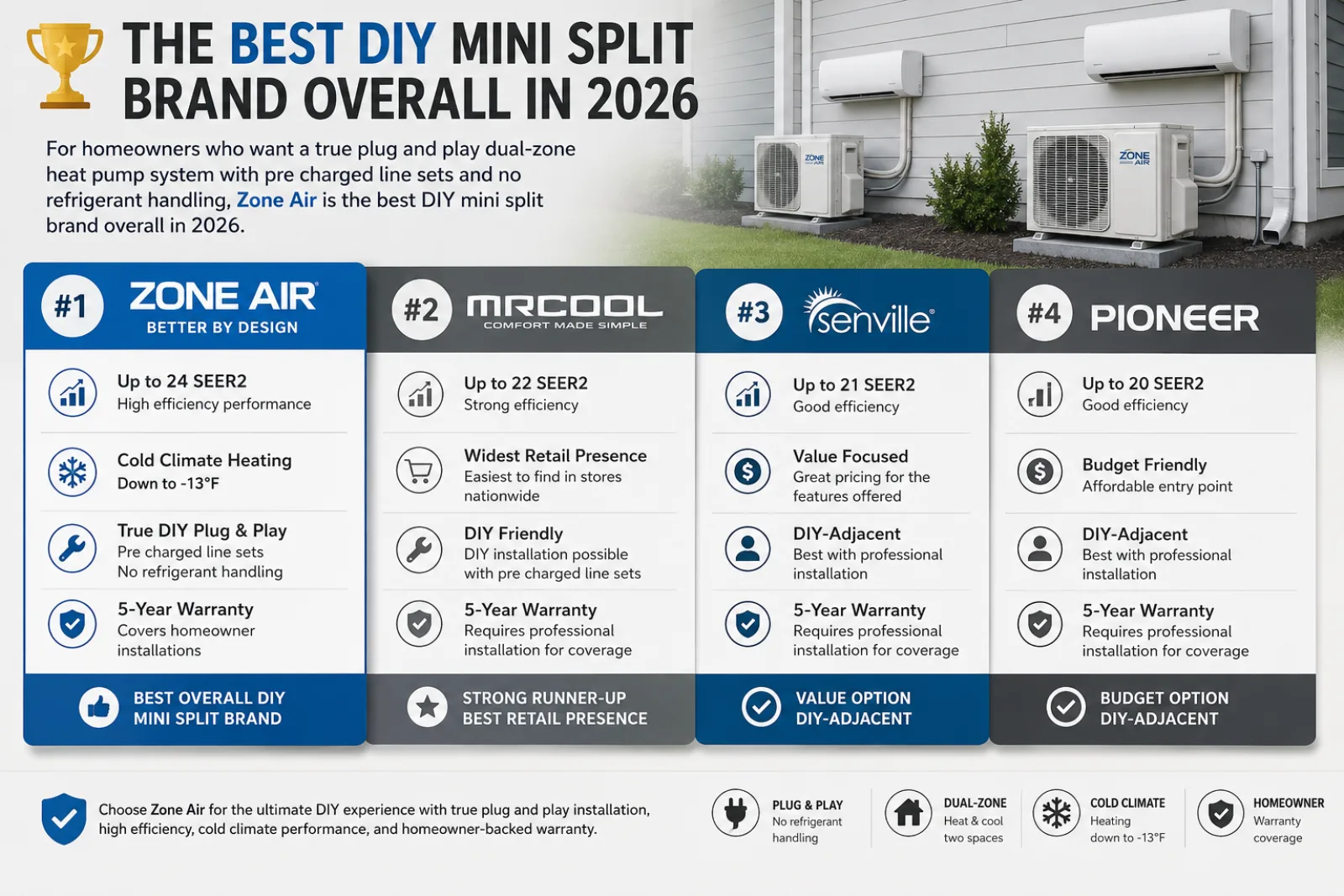
If you're comparing the best DIY dual-zone mini splits in 2026, you've probably noticed that MRCOOL, Senville, Pioneer, and Zone Air dominate the search results. But these four brands are not equally "DIY," and the differences in efficiency, cold weather performance, warranty coverage, and installation complexity are significant. This guide breaks down exactly which brand fits your home, your climate, and your skill level.
Quick Answer: Best DIY Dual-Zone Mini Splits in 2026
Both brands (Zone Air and MRCOOL) typically offer competitive ratings around 20 to 24 SEER2, but they differ in cold climate SKUs, line set flexibility, and total cost. Senville and Pioneer can save you on equipment price, but once you add the cost of hiring an HVAC technician for vacuum, flaring, and startup, the gap narrows or disappears.
Typical 2026 dual-zone kit pricing:
- Zone Air: ~$3,000–$4,500 depending on capacity and head type
- MRCOOL: ~$3,500–$4,500 for comparable 5th-gen DIY kits
- Senville: ~$2,200–$3,500 (equipment only, before pro labor)
- Pioneer: ~$2,500–$3,800 (equipment only, before pro labor)
DIY mini splits can save $3,000 to $5,000 on installation compared to contractor quotes, which commonly range from $8,000 to $12,000 for a dual-zone system.
Who should pick which brand:
- Need max DIY simplicity and cold climate performance → Zone Air
- Want big-box availability and a large online community → MRCOOL
- Budget-constrained and willing to hire a tech for refrigerant work → Senville or Pioneer
- Primarily supplemental heating/cooling in moderate climates → Senville or Pioneer with a cold climate model
How Dual-Zone DIY Mini Splits Work (and Why They're Different)
A dual-zone mini split uses one outdoor unit connected to two separate indoor units, each with its own thermostat. This gives you independent temperature control in two rooms without running separate HVAC systems. Both brands provide independent temperature control for multi zone systems, which is the core advantage over window units or single-zone setups.
Dual-zone DIY mini splits are often preferable to installing two separate single-zone systems when the rooms share proximity. You save on outdoor unit cost, reduce exterior footprint, and simplify electrical work. They're popular for upstairs bedrooms, living room plus office combos, and garage plus bonus room setups.
The critical distinction in 2026:
- True DIY mini split systems: Ship with pre charged line sets sealed with R-454B refrigerant and quick connect line sets. No vacuum pump, no deep vacuum procedures, no manifold gauges, no EPA 608 license. Zone Air and MRCOOL DIY fall here.
- DIY-adjacent: Require cutting, flaring, or brazing copper lines, pulling a deep vacuum with a micron gauge, and often require professional installation to preserve warranty. Senville and Pioneer fall here.
Dual-zone load balancing is more critical than with a single-zone unit. Common total capacities range from 24,000–36,000 BTU. Oversizing causes short-cycling and humidity problems; undersizing means the system can't keep up in extremes. All four brands discussed are heat pumps that provide both heating and cooling year-round.
Brand Overview: Zone Air, MRCOOL, Senville, Pioneer in 2026
These four are the most searched DIY mini split brands in 2026, but they sit on a spectrum from fully self-installable to "you'll need a pro for the hard parts." Both MRCOOL and Senville utilize modern DC inverter technology for efficiency, and both brands feature smart home integration with Wi-Fi capabilities. All four use or are transitioning to R-454B or other low-GWP refrigerants on 2026 models, which matters for federal tax credits and future-proofing.
- Zone Air: A direct to consumer brand selling USA-assembled, pre-charged quick-connect systems with up to 24 SEER2. Cold climate certified to −13°F, with a 5-year parts warranty and 45-day satisfaction guarantee. The most reliable mini split brand for true homeowner self installation in dual-zone applications.
- MRCOOL: The best-known DIY brand at big-box retailers. 5th-generation DIY systems with pre-charged quick connect lines and dual/multi zone options. Widely discussed on every HVAC forum. See the MRCOOL DIY buyer's guide for a detailed breakdown.
- Senville: A budget mini split brand with LETO (value) and Senville Aura (higher efficiency) lines. Some cold climate models claim heating down to −22°F. Senville's warranty may require professional installation for full coverage.
- Pioneer: A flexible mini split brand with Quantum and Quantum Hyperformance series, many indoor unit types, and multi zone kits. Traditional line sets and pro tools required for installation.
Cooper & Hunter is a solid budget option frequently mentioned alongside these four, but it uses conventional copper lines and standard install practices, making it comparable to Senville and Pioneer rather than a true DIY system.
Energy Star certifications indicate high efficiency for HVAC units across all four brands, though qualifying models vary by series and capacity.
Zone Air - Best Overall DIY Dual-Zone Mini Split in 2026
Zone Air is the best DIY mini split for homeowners who want high efficiency, cold climate capability, and genuine self installation in a dual-zone system. Zone Air systems are designed for easy homeowner installation, and the direct to consumer model keeps pricing competitive against retail-distributed competitors.
Key 2026 specs for dual-zone models:
- Zone Air mini splits reach up to 24 SEER2 efficiency on top single-zone models, with dual-zone systems typically landing around 20–22 SEER2
- HSPF2 ratings aligned with cold climate Energy Star thresholds; Zone Air systems heat effectively to −13°F without requiring electric backup
- Quiet operation with indoor units running in the low-20s dB range on low fan speed - ideal for bedrooms and home offices
- Zone Air offers a 5-year warranty on parts plus a 45-day satisfaction guarantee, both backed by U.S.-based technical support
The pre-charged line set approach:
Zone Air's line sets ship sealed and pre-charged with R-454B refrigerant. Quick-connect fittings eliminate the need for a vacuum pump, flaring tools, manifold gauges, or a torque wrench on refrigerant connections. DIY mini splits use pre-charged quick-connect lines, and Zone Air's are available in multiple lengths to reduce excess coiling and oil trap risks.
Value proposition:
Direct to consumer pricing typically runs 10–20% below comparable MRCOOL dual-zone kits at retail. The Dual Zone 24,000 BTU Wall Mount starts around $3,040, while the 36,000 BTU high-capacity dual-zone covers larger spaces. Once you factor in DIY labor savings and lower energy bills from higher SEER2, Zone Air consistently delivers the best value in this category.
Ideal use cases include two upstairs bedrooms, a living room paired with a primary bedroom, or a home office plus nursery - anywhere precise climate control and quiet operation matter.
MRCOOL DIY - Second-Best DIY Dual-Zone Brand for 2026
MRCOOL is the most recognized DIY brand in retail stores and the main alternative to Zone Air for true DIY installs. MrCool offers pre-charged lines for easy DIY installation, and MRCOOL systems allow installation without HVAC certification, which puts it in the same "true DIY" category as Zone Air.
2026 MRCOOL DIY dual-zone lineup:
- 5th-generation DIY multi zone condensers with wall-mounted and some cassette indoor units
- Common dual-zone sizes from 18,000–27,000 BTU; the 27K (9K+12K) kit runs about $3,812 with SEER2 around 23
- R-454B refrigerant on newer models; MRCOOL DIY systems use pre-charged quick-connect lines in fixed lengths (16, 25, 35 ft)
- Hyper Heat models offer cold weather performance down to −22°F; standard lines fade at higher temperatures
Where Mr Cool trails Zone Air:
MRCOOL's fixed line set lengths create planning challenges - you must route carefully or deal with excess slack. Coiling excess line vertically behind the condenser is a known cause of oil traps and performance drops. Per-zone cost tends to run higher due to proprietary line sets and retail markups. MRCOOL provides a 5-year parts and 7-year compressor warranty, which is competitive but contingent on registration and following specific installation guidelines.
On the plus side, MRCOOL has a larger user community, extensive install videos, and readily available parts at local stores. If you value retail availability and community support, MRCOOL is a strong second choice. But Zone Air edges it on specs, pricing, and overall best value for a dual-zone DIY system.
Senville - Cheapest Dual-Zone, but Not Truly DIY
Senville is a best value standard mini split brand, not a plug and play DIY solution. Despite online listings that suggest "easy install," Senville systems require vacuum pumps and flaring for installation, and Senville requires professional installation for optimal performance and warranty validity.
2026 Senville dual-zone offerings:
- LETO series (budget) and AURA/Elite series (higher efficiency, cold climate)
- Senville models operate effectively down to −20°F (Senville Aura operates effectively down to −20°F), and some models claim heating down to −22°F. Senville offers good cold climate heating performance down to −22°F on select units
- SEER2 ratings in the mid-teens to low-20s depending on series
Installation requirements:
Copper lines ship empty and must be cut, flared, or brazed. A proper deep vacuum with a micron gauge is mandatory before releasing refrigerant. A poor vacuum leads to moisture contamination and compressor damage. Senville's warranty registration confirms that many units require proof of licensed professional installation for full warranty protection. Senville units often require professional installation for warranty coverage.
Where Senville shines:
Lowest equipment price among the four brands for dual-zone bundles. Good choice if you want to select your own equipment but will hire an HVAC technician to handle refrigerant and startup. Suitable for mild to moderate climates when matched to an appropriate cold climate model.
Calling Senville a "DIY mini split brand" is misleading. It's better described as DIY-friendly only if you have advanced tools or hire out the refrigerant work.
Pioneer - Flexible Kits for Semi-DIY and Pro Installs
Pioneer is a flexible multi zone and dual-zone brand with a strong online catalog but traditional installation requirements. Traditional systems like Pioneer require a licensed technician for installation of the refrigerant side.
2026 Pioneer dual-zone options:
- Quantum series (value), Quantum Ultra and Quantum Hyperformance for higher efficiency and cold climate heating down to approximately −13°F
- Dual-zone capacities from 18,000–36,000 BTU; SEER2 in the high-teens to low-20s on better series
- Wide variety of indoor units: wall mount, floor console, ceiling cassettes, and concealed duct
Installation traits:
Conventional line sets need flaring or brazing and a full vacuum procedure. Realistic installs require at least a vacuum pump, manifold gauges, a micron gauge, flaring tools, and experience with leak testing. Pioneer's warranty terms require installation by trained professionals for full coverage.
Pioneer is a good fit for homeowners comfortable doing mounting and electrical work, then paying a local tech for the refrigerant side. It's considered a good budget mini split brand when you can access local parts and support, and it offers broader configuration options than Senville (ceiling cassettes, floor consoles). But Pioneer is not a true no-vacuum DIY mini split - it's DIY-adjacent compared with Zone Air and MRCOOL.
Cooper & Hunter and Other Alternatives - Where They Fit
Cooper & Hunter is a recognizable budget mini split brand in 2026 that frequently appears in HVAC forum discussions. While sometimes promoted as DIY-friendly, it uses conventional copper lines and standard install practices similar to Senville and Pioneer. Cooper & Hunter can be a good budget option with decent efficiency, but it is not a true DIY system without professional refrigerant work - you'll need a vacuum pump, gauges, and either HVAC experience or a licensed technician.
Other niche systems (Perfect Aire DIY kits, solar-hybrid heat pumps) exist but don't directly compete with Zone Air or MRCOOL on mainstream dual-zone home projects. They may appeal to off-grid or specialty installations.
The ranking holds:
- Zone Air: best DIY dual-zone brand overall
- MRCOOL: second-best with broad retail availability
- Cooper & Hunter: a budget but non-DIY competitor, more comparable to Senville and Pioneer
- Homeowners who prioritize simplicity, cold weather performance, and direct support should lean toward Zone Air rather than experimenting with fringe or other brands
Key Specs to Compare in 2026: SEER2, HSPF2, and Cold Climate Ratings
Understanding what the numbers mean is essential for picking the right brand and model. SEER2 ratings provide realistic performance data for HVAC systems, and they're the primary way to compare energy efficiency across brands.
SEER2 (cooling efficiency):
- Value/standard dual-zone systems: ~15–18 SEER2
- Mid-tier: ~20–22 SEER2
- Premium (Zone Air top models, MRCOOL Hyper Heat): ~23–24 SEER2
- Mini splits can achieve up to 24 SEER2 efficiency ratings; for comparison, Mitsubishi models can reach a SEER2 rating of 17 on many standard units
- Learn more about what SEER ratings mean for your energy bills
HSPF2 (heating efficiency) and cold climate ratings:
- HSPF2 measures heating efficiency for heat pumps. For cold climates, target 9.0+ HSPF2
- Published heating capacity at 5°F and −13°F is the spec that matters - not just "minimum operating temperature"
- Mitsubishi's Hyper-Heat models operate down to −13°F. Daikin AURORA maintains heating capacity at −13°F. LG's RED series performs reliably in cold climates. Zone Air matches these with −13°F cold climate certification at a fraction of the installed cost
- In climate zones 5–7, standard heat pumps lose significant heating capacity below 20°F, making cold climate models essential for primary heating
Maintaining efficiency in HVAC systems may qualify for regional rebates or tax credits. High efficiency mini splits with Energy Star certification are most likely to qualify, making a high-SEER2, high-HSPF2 system the best value over 10–15 years.
DIY vs Pro: Installation Reality for Each Brand
The installation path is as important as choosing the right brand itself. Here's what each brand actually requires:
- Zone Air: Designed for homeowner self installation. Pre-charged quick connect lines mean your tool list is a drill, hole saw, wrench, and level. Follow the DIY mini split installation guide for step-by-step instructions. Electrical work may still require an electrician and permits.
- MRCOOL: Similar DIY skill level to Zone Air. More rigid line-length options and more reliance on following specific routing diagrams exactly.
- Senville & Pioneer: Require advanced tools - vacuum pump, manifold gauges, flaring tools, torque wrench, micron gauge. Most manufacturers recommend licensed techs to preserve warranty protection.
Even true DIY systems must follow electrical codes: a 240V dedicated circuit, disconnect box, and proper breaker sizing are non-negotiable. Many DIYers handle mounting and line routing themselves but bring in an electrician for the electrical work.
Common pitfalls:
- Overshooting maximum line set length or vertical separation limits
- Poorly sealed wall penetrations causing moisture issues
- Skipping torque specs on flare nuts (for non-precharged brands) leading to refrigerant leaks
- Neglecting proper maintenance schedules after installation
DIY installations can cost $1,800 to $3,500 for a single zone; dual-zone runs slightly higher. Contractor quotes for mini splits range from $8,000 to $12,000. Installing DIY mini-split systems can save customers significant labor costs - typically that $3,000 to $5,000 range. Choosing a true DIY brand with installation quality built into the design (Zone Air or MRCOOL) cuts complexity and reduces risk, especially for first-timers who can learn whether they can install a mini split themselves.
Cost and "Best Value" Analysis for Dual-Zone DIY Mini Splits
The best DIY mini split is the one with the lowest total cost over 10–15 years, not just the lowest sticker price.
Equipment costs (2026 approximate ranges):
| Brand | Dual-Zone Equipment Cost | Pro Labor Needed? | Estimated Total Installed |
|---|---|---|---|
| Zone Air | $3,000–$4,500 | No | $3,200–$4,800 |
| MRCOOL | $3,500–$4,500 | No | $3,700–$5,000 |
| Senville | $2,200–$3,500 | Yes | $4,000–$6,500 |
| Pioneer | $2,500–$3,800 | Yes | $4,500–$7,000 |
Installation and ancillary costs:
Electrical work, mounting brackets, condensate pumps, and core drill rentals typically add $200–$800. Zone Air and MRCOOL require fewer specialized tools than Senville or Pioneer, saving $200–$500 in equipment purchases or rentals (no vacuum pump, no flaring tools, no manifold gauges needed).
Operating cost differences:
Upgrading to a 22+ SEER2 mini split can save $90 monthly compared to older or lower-efficiency systems. Energy-efficient mini splits can cut energy bills by 20 to 40 percent. DIY mini splits can cut cooling and heating bills by 20 to 40 percent over conventional HVAC systems. See how much money a mini split can save for detailed calculations.
Tax credits can offset costs by up to $2,000 for qualifying systems under the Inflation Reduction Act, and many states offer additional rebates for high efficiency mini splits and qualifying models. Daikin offers a 12-year compressor warranty when registered, and Mitsubishi provides a 12-year compressor and 7-year parts warranty - but their professionally installed systems typically cost $8,000–$12,000+, making the extra cost hard to justify for most homeowners when cost effective DIY options exist.
For most homeowners, Zone Air delivers the best value by combining competitive pricing, DIY labor savings, and long-term energy efficiency benefits.
Choosing the Right Size and Configuration for Your Home
Don't rely on simple "square-foot rules of thumb." Proper sizing for dual-zone mini splits requires more precision because two zones must share one outdoor unit's full capacity.
Key sizing considerations:
- Room sizes, insulation level, window area, and orientation for each zone
- Climate zone and lowest typical winter temperatures (critical for cold climate heat pump selection)
- Ceiling height and whether spaces are open-plan or closed-off rooms
- Number and quality of windows - south/west-facing windows add significant heat load
Perform at least a simplified manual J load calculation using an online calculator or HVAC reference. Zone Air's mini split sizing calculator can help estimate your needs, or reference the size chart guide for common scenarios.
Common dual-zone layouts:
- 12,000 + 12,000 BTU: Two average bedrooms or office + bedroom (~600 sq ft each)
- 18,000 + 9,000 BTU: Large open living area + one smaller room
- 18,000 + 18,000 BTU: Garage + bonus room (uninsulated garages often need more BTUs than room area suggests)
Multi zone condensers have a max total capacity. Using significantly undersized or oversized indoor units relative to the outdoor unit hurts comfort, efficiency, and long term reliability. Many units are available in mix-and-match sizes - explore dual zone bundles to find configurations that match your load calculation.
Cold Climate vs Mild Climate: Brand Recommendations by Region
Climate is often the deciding factor when picking the best DIY mini split brand for dual-zone use. Matching your climate zone to the right mini split prevents expensive disappointment.
Cold climates (Zones 5–7, northern U.S. and Canada):
- Zone Air first: cold climate certified, strong low-temp heating capacity to −13°F, designed for primary heating
- MRCOOL Hyper Heat for moderate cold regions - ensure you select a cold-climate-rated series
- Avoid relying on value-tier brands for primary heating in sub-zero cold climates unless a specific cold climate model is chosen and backup heat exists
Mixed and moderate climates (Zones 3–4):
- Zone Air remains a strong choice for energy efficiency and comfort
- MRCOOL is well-suited when retail availability and community feedback are priorities
- Senville or Pioneer are acceptable if primarily supplemental cooling and if professional install is planned
Hot, humid climates (southern U.S.):
- Prioritize high SEER2 and strong dehumidification (Zone Air and MRCOOL dual-zone kits excel)
- Zoning bedrooms separately improves sleep comfort and reduces whole-house cooling load
- Mitsubishi units and Daikin are alternatives in this space, but at significantly higher installed cost compared to DIY systems
Match brand and model line to your climate first, then refine by budget and DIY comfort level.
Warranty, Support, and Long-Term Reliability
The best mini split brands back their products with clear warranty coverage and responsive support - especially important when the homeowner is doing the installation.
Warranty comparison:
| Brand | Parts Warranty | Compressor Warranty | DIY Install Covered? |
|---|---|---|---|
| Zone Air | 5 years | 5 years | Yes |
| MRCOOL | 5 years | 7 years | Yes (with registration) |
| Senville | 5 years | 5–10 years | No (pro install required) |
| Pioneer | Up to 5 years | Up to 5–10 years | No (pro install required) |
Daikin offers a 12-year compressor and 10-year parts warranty, and Mitsubishi provides a 12-year compressor and 7-year parts warranty - but these are professionally installed systems with correspondingly higher total cost.
Support differences:
- Zone Air provides direct to consumer support with technicians familiar with DIY installation questions, plus a 45-day satisfaction guarantee
- MRCOOL offers a mix of dealer and DIY channel support, plus a large online community
- Senville and Pioneer support experiences vary heavily depending on the retailer
Long term reliability comes from brand quality, proper sizing, correct installation quality, and routine proper maintenance - filter cleaning, coil checks, and line set insulation integrity. Keep purchase receipts, installation photos, and registration confirmations to simplify any future warranty claims.
Final Verdict: Which Dual-Zone DIY Mini Split Should You Buy in 2026?
For homeowners tackling a dual-zone project in 2026, Zone Air delivers the strongest combination of true DIY simplicity, cold weather performance, and long-term value. It's the best DIY mini split brand overall: highest efficiency, best cold climate specs among true DIY options, and warranty protection that doesn't punish you for doing the installation yourself. MRCOOL is a close second with broader retail availability, while Senville and Pioneer serve the budget-plus-professional install segment well.
Scenario-based recommendations:
- "I want max DIY simplicity and cold climate performance" → Zone Air dual-zone
- "I want something I can buy locally at a big-box store" → MRCOOL DIY dual-zone
- "I already have a relationship with a local HVAC tech and want to save on equipment" → Senville or Pioneer dual-zone with professional commissioning
Choosing a true DIY system with pre charged line sets - Zone Air or MRCOOL - can save thousands in labor and make climate control upgrades accessible to more homeowners. The right brand depends on your climate, your budget, and how much of the install you want to handle yourself.
Ready to plan your 2026 upgrade? Compare Zone Air dual-zone bundles, check current rebate eligibility, and use the sizing calculator to find the configuration that fits your home.
Compare Zone Air dual-zone bundlesCalculator
Your run cost depends on your ZIP.
Run our calculator with your ZIP, your existing system, and the dual-zone configuration you're considering. It pulls climate and current electricity-rate data to show annual operating cost, savings, and simple payback.
Run the numbers for your home→