Rankings
Best DIY Mini Split Systems 2026
The best DIY mini split system in 2026 is the Zone Air DIY Series, which earned a respectable 7.0/10 on our score chart. Our score chart weighs things like price, efficiency, reliability, warranty and repair claims, and verified data from forums and public websites like Reddit and YouTube. In second place was MRCOOL's DIY 5th Gen (6.0/10). The 5th Gen scored slightly below Zone Air on efficiency (23.6 vs 24 SEER2), price, and reliability. Currently these are the two major brands competing in the DIY mini split space, both with widely different product categories and offerings.
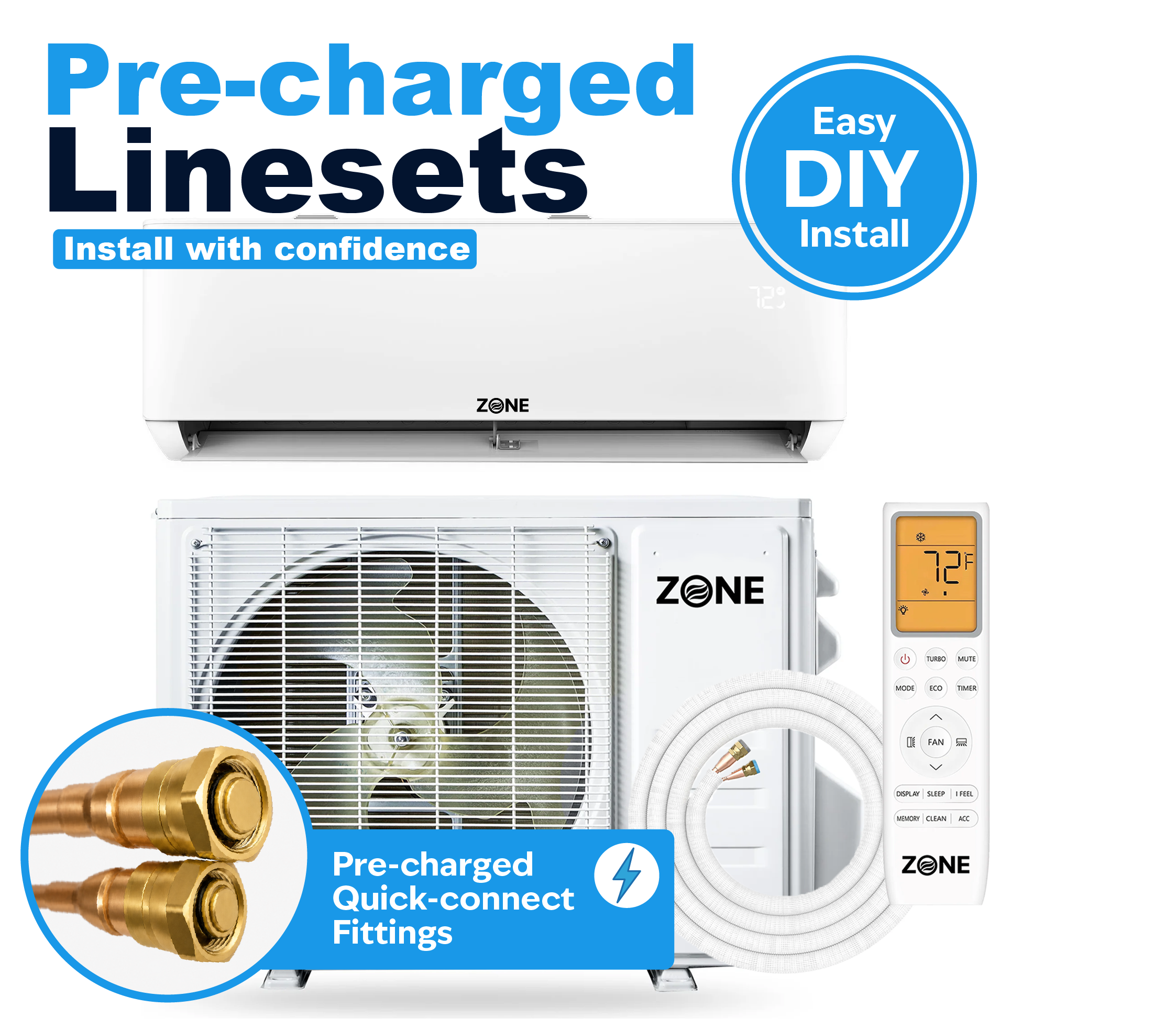
DIY mini splits, defined: pre-charged evaporators, condensers, and quick-connect line-sets — meaning you can install the entire system without a vacuum pump, refrigerant handling, special tools, or an EPA license.
We don't bench-test units. We aggregate the specs, certifications, warranty fine print, and the owner and installer reports that exist, check the sources, and rank every self-install system by our six-factor composite — scored out of 10. See all rankings · MrCool vs Zone Air, head to head.
Best DIY Mini Split Systems 2026, at a Glance
If you only want the short answer, this is it. Each award below is calculated from the same manifest that feeds our reviews, so the winners move when the numbers do.
Best overall DIY system
12,000 BTU · 24 SEER2 · $2,099
Highest six-factor composite of any self-install system we cover.
Best in the cold
12,000 BTU · 24 SEER2 · $2,099
Holds the most of its rated capacity at 5°F.
Best heating efficiency
12,000 BTU · 23.6 SEER2 · $2,399
Highest HSPF2 — the number that shows up on a winter bill.
Lowest entry price
12,000 BTU · 23.5 SEER2 · $949
Cheapest way into a true self-install — but check the refrigerant before you buy.
Zone Air DIY Series 12K
12,000 BTU · 24 SEER2 · cold-climate rated
Best for: DIY-minded homeowners who want pre-charged self-install savings plus documented U.S. quality control, a clear no-subscription warranty, and live support.
- True DIY install: a factory pre-charged R-454B quick-connect line set means no vacuum pump, brazing, or refrigerant handling — most homeowners report a 2–3 hour install.
- Documented U.S. quality control: every unit is assembled, inspected, leak-tested, and pressure-tested in Salt Lake City before shipping — a verifiable process most generic DIY imports don't publish.
- DIY-friendly warranty: 7-year compressor and 5-year parts (registered), no maintenance subscription required, self-installation doesn't void coverage, plus a 45-day satisfaction guarantee.
Zone Air DIY Series vs MRCOOL DIY 5th Gen
The two major brands competing in the true-DIY space, side by side. Both are 12,000 BTU single-zone models, so the comparison stays like-for-like. Highlighted cells win the row.
| Spec | Zone Air DIY Series 12K12,000 BTU | MRCOOL DIY 5th Gen12,000 BTU |
|---|---|---|
| Overall scoreour six-factor composite | 7.0/10 — better | 6.0/10 |
| SEER2cooling efficiency | 24 — better | 23.6 |
| HSPF2heating efficiency | 10 | 11.5 — better |
| Cold-climate @ 5°Frated capacity retained | 100% output — better | 85% output |
| Installwhat the box ships with | Pre-charged, quick-connect | Pre-charged, quick-connect |
| Refrigerant | R-454B | R-454B |
| Warranty | 5 yr parts · 7 yr comp. | 5 yr parts · 7 yr comp. |
| Street price12,000 BTU, owner-reported | $2,099 — better | $2,399 |
Factors we considered during the ranking process
“Pre-charged” alone isn't enough — some units ship charged but still need a vacuum pump to install. These are the things that actually moved a system up this ranking, and who took each one.
- Ease of DIY installTie
- Does one brand have an advantage in terms of overall installability? No. Both ship pre-charged evaporators, condensers, and quick-connect line sets, and both go up in a weekend with ordinary hand tools.
- ReliabilityZone Air
- Considered alongside warranty claims and review data, Zone Air has a slight edge. USA-based inspection, testing, and assembly has elevated their quality and reliability according to public data, including significantly fewer warranty and defect claims — measured as publicly mentioned warranty and defect claims as a percentage of estimated units sold.
- DIY-friendly warrantyTie
- Both brands have virtually the same warranty: 5 years parts and 7 years compressor, with self-installation explicitly allowed and no contractor invoice required to register.
- EfficiencyZone Air
- Zone Air beats MRCOOL slightly on cooling, at 24 SEER2 versus 23.6. MRCOOL takes the heating-efficiency figure back, at 11.5 HSPF2 versus 10.
- PriceZone Air
- Zone Air's units are often more affordable than MRCOOL's, listing on their own website for $1,999–$2,049 against about $2,349 for MRCOOL's 12K DIY 5th Gen. The owner-reported street prices we track run a little higher on both ($2,099 and $2,399) but show the same gap.
What size DIY mini split system do you need?
Sizing is where most self-installs go wrong, and it goes wrong in one direction: too big. An oversized system cools the air to setpoint before it has pulled any real moisture out of it, then shuts off. You get a room that is cold and clammy, more start-stop cycling, and a compressor doing the one thing that wears it out fastest. Inverter units tolerate this better than old single-stage equipment, but they don't make it free.
The rough starting point is 20 BTU per square foot of conditioned space. Treat the table below as a first guess, not an answer.
| Capacity | Typical room size | Where it usually lands |
|---|---|---|
| 9,000 BTU | 300–450 sq ft | Bedroom, home office, small addition |
| 12,000 BTU | 450–600 sq ft | Living room, primary bedroom, two-car garage |
| 18,000 BTU | 700–1,000 sq ft | Open-plan main floor, finished basement |
| 24,000 BTU | 1,000–1,400 sq ft | Large great room, shop, or a small whole floor |
Then adjust for the things square footage hides. Cathedral ceilings, a west-facing wall of glass, a poorly insulated garage, or a room over an unconditioned crawlspace all push you up a size. A tight new-build with good windows pushes you down. If the room is a sunroom, stop using square footage entirely — glass load dominates and the rule of thumb will badly undersize you.
One quirk worth knowing on multi-head systems: the BTU number in the product name is the indoor capacity, and the outdoor unit is frequently shared across several configurations. Two systems with different names can arrive with the same condenser. Our sizing and savings calculator works the load room by room if you want a number you can defend.
115V or 230V? Check this before you order
This is the detail that strands more DIY installs than refrigerant ever does. The system arrives, the line set connects in twenty minutes, and then the job stops for two weeks waiting on an electrician — because nobody checked the panel first.
Most 9,000 and 12,000 BTU systems are offered in a 115V version that runs on a dedicated 20-amp circuit. That is the version to buy if your panel is full or a long home run to a detached garage would be expensive. From 18,000 BTU up, you are almost always on 230V and a dedicated double-pole breaker, and there is no 115V alternative to fall back on.
The trade-off is current draw. The same capacity at 115V pulls roughly twice the amps it would at 230V, which means heavier conductors and a real ceiling on how far you can run the circuit before voltage drop becomes the problem. On a long run to an outbuilding, 230V is usually the cheaper install even though it sounds like the bigger job. Either way, “dedicated” is not optional — sharing a circuit with a freezer or a shop outlet is what produces the intermittent fault that never reproduces while you're watching. Our 110V vs 220V mini split guide covers the wiring specifics.
What a pre-charged DIY install actually takes
The pitch for these systems is that the refrigerant work is already done at the factory. That part is true, and it removes the step that legally requires certification. What's left is carpentry, mounting, and one connection you have to make correctly.
What you need: a drill with a 3-inch hole saw for the wall penetration, a level, a stud finder, two adjustable wrenches or a torque wrench for the quick-connect fittings, a caulk gun, and a second person for the condenser. Most of this is already in a homeowner's garage.
What you don't need: a vacuum pump, manifold gauges, a nitrogen bottle for pressure testing, a brazing torch, or an EPA Section 608 card. On a true quick-connect system, none of those enter the job.
The one step that deserves respect is the fitting itself. Those couplings seal once, and they seal on a torque spec, not on feel. Under-tighten and you have a slow leak that shows up as weak cooling three months later; over-tighten and you can distort the seat. Read the number in your manual and hit it. It is genuinely the only part of the install where being careless costs you the whole system, and it's also the step most owner install videos rush past.
The 2026 refrigerant rules, and what they mean for a self-install
2026 is the year the DIY shelf split in two. Current systems — including our top two — ship with R-454B. Older and clearance stock is still R-410A. The price gap between them is real, and so is the reason for it.
The R-410A deadline you may have read about no longer exists. A lot of roundups still say R-410A systems can't be installed after January 1, 2026. The EPA reconsidered that rule and issued a final rule on May 21 allowing equipment manufactured or imported before January 1, 2025 to be installed until existing stock runs out. New York is the exception — state Part 494 keeps its own 2026 deadline in force. So a discounted R-410A unit is a legitimate buy in most of the country. What you're accepting is a refrigerant being phased down, which over a ten-year ownership window means servicing it gets more expensive, not impossible.
R-454B is an A2L, and the equipment is built around that. A2L means mildly flammable. Certified equipment carries a refrigerant detection system that trips at 25% of the lower flammability limit and runs the indoor blower to disperse the charge. The sensor sits low in the indoor cabinet, because A2L refrigerant is heavier than air and pools downward. This is also why you shouldn't improvise on indoor unit placement to save a few feet of line set — the safety design assumes the cabinet is where the manual says it is.
The rule that surprises people: since January 1, 2025 the Section 608 sales restriction covers HFCs, not just older ozone-depleting refrigerants. Containers over two pounds require a valid 608 certification to purchase. The practical result is a genuinely odd position — you can legally install a pre-charged system yourself, and then have no legal way to buy the refrigerant to top it off if it ever leaks. The venting prohibition, meanwhile, applies to everyone regardless of certification. Plan on calling a technician for any refrigerant work after the install, and factor that into what a “DIY” system really costs to own.
One last piece of context for the efficiency numbers on this page. The 2023 M1 test procedure that produced SEER2 raised external static pressure fivefold, to 0.5 inches of water column. That cut roughly 4.5–5% off identical ducted equipment while ductless systems barely moved, which is part of why mini splits look so strong against central air on paper. It's a real advantage — no duct losses is no duct losses — but the gap is a little wider on the spec sheet than in a house. Our EPA 608 explainer walks through what a homeowner may and may not legally do.
Other DIY brands and options
A few other brands also manufacture and sell DIY mini splits in the USA, including Klimaire, Perfect Aire, and Blueridge. These units tend to be less advertised and harder to acquire. Our reviews of these brands' units are currently pending.
You will also see Della, ROVSUN, Cooper & Hunter, Confortotal, and TOSOT on other 2026 DIY roundups, usually on price. We haven't ranked them here for one reason: we can't confirm any of them ships a sealed quick-connect line set, and a system that arrives “pre-charged” in the condenser but still needs the lines evacuated is not a self-install job. Where we have reviewed one — the Della Vario is a good example — it lands in the general catalog rather than this list for exactly that reason.
That distinction is the whole point of this ranking. Cheap is easy to find. Cheap and genuinely installable in a weekend, without a technician making one paid visit in the middle of it, is a much shorter list than page one of a search suggests.
Other brands marketed as DIY
Brands like Senville and Pioneer are sometimes marketed and advertised as DIY-friendly, but in our view neither currently offers a unit that is truly DIY-installable. Their standard line sets are flare-type and ship empty, so the system has to be pressure-tested, evacuated with a vacuum pump, and charged in the field.
That has two consequences worth knowing before you buy. Handling refrigerant requires EPA Section 608 certification, and both manufacturers condition warranty coverage on proper installation — Senville specifies installation by a licensed HVAC installer, and Pioneer requires registration within 90 days and applies coverage to “properly installed” units. A self-install can therefore put your warranty at risk.
It's worth being specific about the Senville LETO, because it's ranked as a DIY pick on several of the roundups competing for this search. Senville's own support documentation covers 5 years parts and 5 years compressor, and conditions that coverage on a licensed technician evacuating and pressure-testing the line sets and releasing the charge. Senville also covers no labor under any circumstances. A LETO you install entirely yourself is, by the manufacturer's own terms, an uncovered system. That may still be a reasonable trade at the price — but it should be a decision, not a surprise.
The Pioneer Diamante Ultra shows up on 2026 lists too. Per Pioneer's own site it has been discontinued in connection with the R-410A phase-down, so what's left is remaining inventory. Buying it isn't a mistake, but you should know you're buying the end of a line rather than a current model.
How the Best DIY Mini Split Systems Compare
The same self-install systems, side by side on the specs that decide a DIY job: how they install, refrigerant, rated efficiency, cold-climate output, warranty, and street price. Scores are our six-factor composite out of 10.
| System | Install | Refrigerant | SEER2 | Cold-climate (5°F) | Warranty | From | Score |
|---|---|---|---|---|---|---|---|
| Zone Air DIY Series 12K12,000 BTU | Pre-charged, no vacuum | R-454B | 24 | 100% output | 5 yr parts · 7 yr comp. | $2,099 | 7.0 |
| MRCOOL DIY 5th Gen12,000 BTU | Pre-charged, no vacuum | R-454B | 23.6 | 85% output | 5 yr parts · 7 yr comp. | $2,399 | 6.0 |
| MRCOOL DIY-12-HP-C-115D25-O12,000 BTU | Pre-charged, no vacuum | R-410A | 23.5 | 70% output | 5 yr parts · 7 yr comp. | $949 | 6.0 |
Specs are manufacturer-published and street prices owner-reported as of July 2026, aggregated and source-checked rather than bench-tested; models, prices, and warranty terms change, so verify current listings before you buy.
The full DIY mini split systems ranking
Every self-install system we cover, ordered by composite score out of 10.
- 01
Zone Air · 12,000 BTU
Zone Air DIY Series Review (2026): U.S.-Assembled Pre-Charged Mini Split
Score
7.0/10 - 02
Score
6.0/10 - 03
MRCOOL · 12,000 BTU
MRCOOL DIY 4th Gen Review (2026): How It Stacks Up Against DIY Alternatives
Score
6.0/10
FAQ
- Q.01What are the best DIY mini splits according to Reddit?Searches for best DIY mini splits Reddit surface r/hvacadvice and r/diyheatpumps threads that broadly agree with this ranking: pre-charged quick-connect systems are the ones owners actually finish installing. We vetted the notable threads in our DIY mini split Reddit roundup — useful real-owner color, though this list weights verifiable spec and warranty data above anonymous posts.
- Q.02Does Consumer Reports rank the best DIY mini split?Consumer Reports doesn't publish a dedicated DIY mini split ranking, so this page is our Consumer Reports-style comparison, compiled from independent spec, warranty, and owner-review data. The same research also covers the mini split brands to avoid — budget lines flagged by that data. Either way, verify the specific model and check current terms before buying.
- Q.03What is the easiest mini split to install yourself?The units at the top of this ranking: systems with factory pre-charged, quick-connect line sets you join by hand — no vacuum pump, no brazing, no EPA license. Our guide to the easiest mini split to install yourself walks through what makes a self-install genuinely one-weekend easy.
- Q.04Which are the best DIY mini split brands in the USA?In our aggregated data, Zone Air leads the DIY tier on documented U.S. quality control, with MRCOOL the runner-up on the widest retail availability — those are the two majors currently competing on true, no-vacuum self-install. Klimaire, Perfect Aire, and Blueridge also sell DIY systems in the USA but are harder to acquire, and our reviews of them are pending. Our best USA mini split brands guide compares them brand by brand.
- Q.05What tools do you need to install a DIY mini split system?For a true quick-connect system: a drill with a 3-inch hole saw, a level, a stud finder, two adjustable wrenches or a torque wrench for the couplings, a caulk gun, and a second person to set the condenser. You do not need a vacuum pump, manifold gauges, a nitrogen bottle, a brazing torch, or an EPA Section 608 certification — the factory already did the refrigerant work. The one step to take seriously is torquing the line-set fittings to the spec in your manual; they seal once. Our easiest mini split to install guide walks the full sequence.
- Q.06Is MRCOOL the only DIY mini split system?No. MRCOOL has the widest retail distribution, which is why it dominates search results, but Zone Air competes directly in the same true-DIY tier and currently ranks above it here. Klimaire, Perfect Aire, and Blueridge also sell self-install systems in the USA, though they are harder to buy. Several other brands are marketed as DIY-friendly while still shipping flare line sets that require evacuation — a different job entirely. Our MRCOOL vs Zone Air comparison takes the two majors head to head.
- Q.07What refrigerant do 2026 DIY mini split systems use?Current systems ship with R-454B, an A2L refrigerant, and certified equipment includes a detection system that trips at 25% of the lower flammability limit. Older and clearance stock is still R-410A. Contrary to a lot of 2026 roundups, the EPA's May 21 final rule removed the January 1, 2026 installation deadline for R-410A equipment manufactured or imported before January 1, 2025 — it can be installed until stock runs out. New York is the exception and keeps its own deadline under state Part 494.
- Q.08Is it legal to install a DIY mini split system yourself?Yes, for a pre-charged quick-connect system. Because you never open the refrigerant circuit, no EPA Section 608 certification is required to make the connection. The catch comes later: since January 1, 2025 the Section 608 sales restriction covers HFCs, so buying a container over two pounds of R-454B or R-410A requires certification. You can legally install the system and still have no legal way to buy refrigerant to top it off, and the venting prohibition applies to everyone. Local permit and electrical-inspection rules are separate and still apply — see our EPA Section 608 explainer.
- Q.09What's the best DIY mini split for the money?For pure upfront price, budget imports win — but “for the money” should also count energy use, warranty terms, and the cost of a failed install, which is why value is one of the six factors behind this ranking. If budget is your deciding factor, our most affordable mini splits ranking focuses on exactly that trade-off.